Complete
- One shared plan, no central controller
- Builds that survive losing robots mid-job
- Vision-guided assembly, checked placement by placement
We develop decentralized robotic construction: fleets of robots that share one plan, choose their own work and check every placement. No central controller.
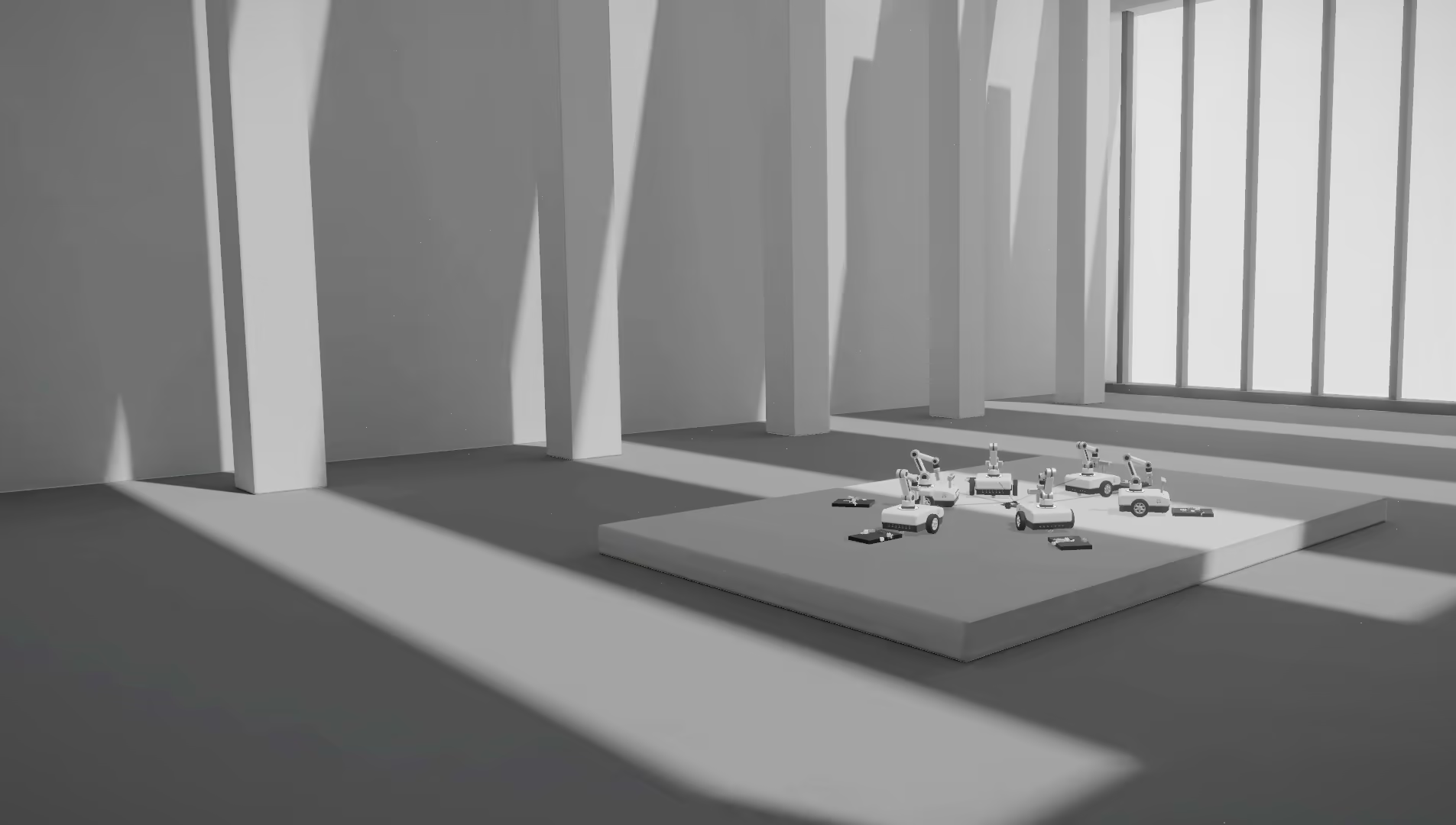
LEGOSwarm is our research platform. Its robots assemble LEGO structures, a precise and testable stand-in for structured physical work.
Visualization

01 The worker
Each worker is a self-contained mobile manipulator. A two-wheeled base handles coarse positioning across the build field. A compact arm handles fine placement.
Onboard AI compute runs perception, planning and the swarm software. Beside it, a real-time microcontroller keeps the wheels and the safe state on time.
Artistic visualization

02 Inside the worker
Taken apart, the worker is a short list of clear responsibilities. Select one to see what it does.
Two geared motors with encoders turn the wheels. The base gets the robot close; the arm does the rest.
An octa-core Linux processor with an NPU of up to 40 TOPS runs perception, planning and the swarm. A real-time microcontroller owns the wheels and the safe state.
Colour plus depth. It finds parts, guides the grasp and checks each placement.
An articulated arm for local positioning and controlled insertion. Its actuators are still being chosen.
Compliant and force-limited, so a brick seats firmly without pushing the robot back.
One battery behind a main fuse. The main switch is the hard stop.
Show the robot's state to people nearby. They display; they never decide.
A low, stiff frame that keeps the battery and electronics close to the floor.

03 Building together
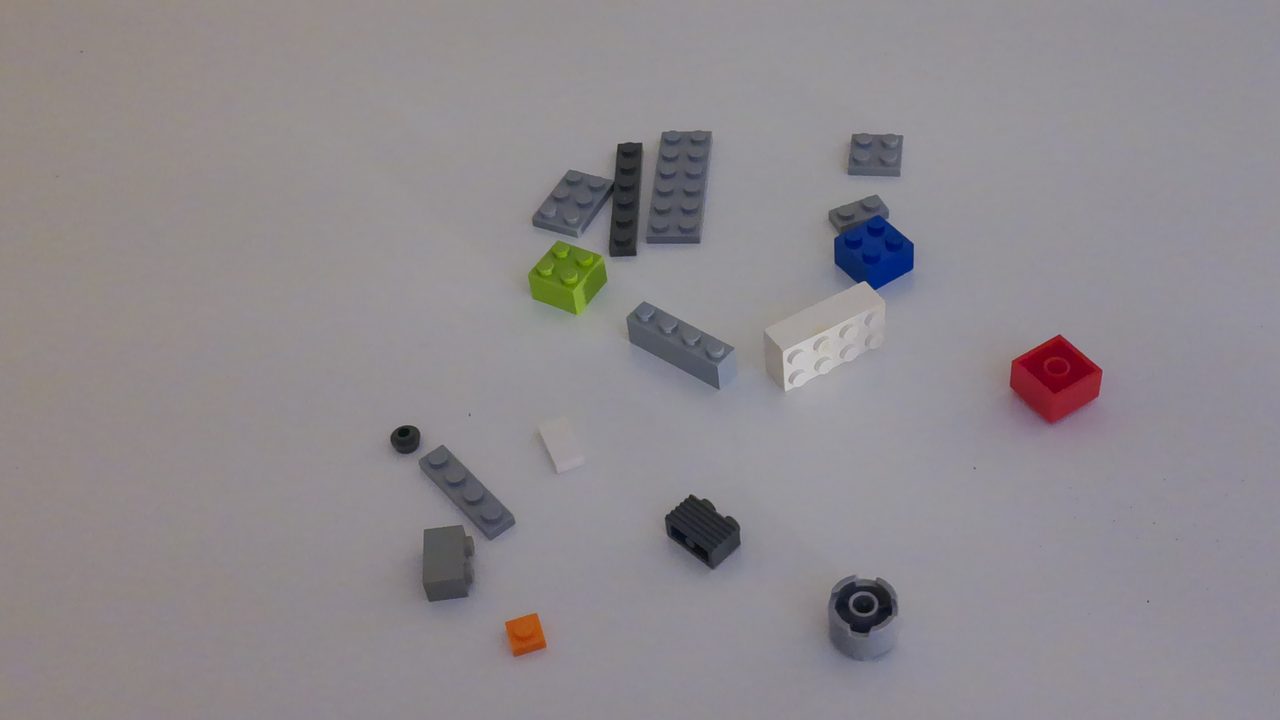
Every worker carries a copy of the same plan, the Assembly Graph. Each brick is a job. A job becomes available only when the bricks beneath it are complete.
About two messages per job. No polling, no scheduler. If a robot stops mid-job, its claim expires and a peer takes over. In simulation, builds still complete after losing a third of the robots.
Visualization · real 61-brick assembly graph

04 The shared plan
Yet every robot knows where the project stands. WEAVE, the Workload Execution and Autonomous Verification Engine, treats construction as a shared record of events, not a stream of commands.
People define the outcome. It is authored once into the plan, and robots never rewrite it.
The authoritative plan: one node per job, edges for what must come first. Every robot holds a versioned replica.
Robots pull work; nobody assigns it. A claim is a lease that must be renewed, so a silent robot's work reopens on its own.
An append-only history of claims, placements and revisions. Replaying it brings every robot to the same state.
Each robot checks its own work against the plan. A failure releases the job for a retry instead of passing the error on.

05 Beyond the arena
LEGO is the proving ground: precise, repeatable and honest about every mistake. The architecture aims at structured physical work wherever links are slow, networks split and machines fail. Remote sites. Hazardous ground. One day, construction beyond Earth.
Concept · not a current capability

06 Where it stands
